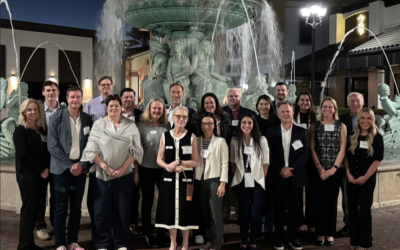

On Thursday, December 4, the FACILITATE closing event Returning Individual Participant Data in Clinical Trials ‘by Design’. Setting a new standard for Patients’ Rights in Europe took place at the European Parliament in Brussels. The event was highly successful to raise awareness for FACILITATE, stimulating lots of feedback, posts, and comments. There were about 80 online participants, with 60 people attending in person.

The program for this relevant meeting was moderated by Nuala Ryan, Public Private Partnership Team (Takeda), Clinical Research Consultant and Patient Advocate. The European Parliament kicked off proceedings with an introductory speech by MEP Vytenis Andriukai (S&D Group, Lithuania) and a presentation by the European Commission’s Elmar Nimmesgern, who reiterated how FACILITATE is an example of the added value of IMI/IHI projects and how it is part of the broader effort to strengthen clinical research in Europe, as highlighted in the Letta and Draghi reports.

“The European Commission is taking on this challenge” emphasized Nimmesgern. “For example, through the collaboration with EMA and Member States in ACT EU to accelerate clinical trials in the EU. In the life sciences communication from July this year clinical research features prominently, a flagship clinical research investment plan was announced,
and we are working on developing this. An invitation-only workshop later this month will look at some aspects to be considered for the clinical research investment plan: infrastructures, scaling national ‘single entry points for clinical trials’, new funding models and collaboration amongst funders and better support to SMEs.”

After the introduction, the first session of the meeting focused on project’s main results by Johanna Blom, FACILITATE Coordinator; Professor of Psychobiology, University of Modena e Reggio Emilia (UNIMORE) and Cris Woolston, Global Head of Science Policy (Sanofi). Blom and Woolston explained why returning individual data matters: it respects participants’
commitment and preferences, enables understanding and informed decisions in care and daily life, builds trust and transparency, and shows that taking part has value, encouraging future engagement. Examples from their presentation illustrated how returned data can give a clearer picture of key measures and trends, support medical management and
informed choices, and improve care while reducing burden.

The FACILITATE Principles were then presented by Daniela Quaggia (Cittadinanzattiva – Active Citizenship Network) as a practical roadmap for implementation.
- Plan it from day one-specify what will be returned, how, and when in the protocol; design a continuous “return path” into the post-trial phase.
- Put participants first-codesign with representative patient groups and ensure meaningful, consistent involvement.
- Provide equitable access-ensure comparable access across sites/countries/populations; adapt communications to disability and digitalliteracy needs.
- Be transparent and accountable-clarify who does what, when, and how; provide accessible support channels.
- Support understanding-use plain language, offer clinical touchpoints when needed, and train all stakeholders.
- Learn and improve-measure delivery/experience, address gaps, and share both successes and challenges.

The endorsement slides underscored momentum: as explained during the presentation, the Principles had been circulated first among patient and civic associations to seek endorsement. Over 50 organisations had confirmed their endorsement by the time of the event, with more expected. Some research institutes had already asked to endorse and published the Principles on their websites, signalling cross-stakeholder alignment.

Finally, a multi-stakeholder roundtable discussed the implications of the FACILITATE project for research, patients, and policy. When asked about the implications of the FACILITATE results for patient associations, Nadia Malliou, invited speaker at the roundtable, stated: “Representing Pain Alliance Europe and as a participant in the FACILITATE EU project, I found the results particularly meaningful from the patient perspective. The project provides clear reassurance that patients’ voices and rights are central to how health data is managed. For patients, FACILITATE demonstrates that data is not just a technical resource but part of their personal story.”
In the context of FACILITATE, the Data Manager plays a pivotal role in facilitating the return and proper management of clinical research data, ensuring compliance, trasparency, quality, and patient protection. In her role as Data Manager at the Italian Group of Data Managers & Clinical Research Coordinators (GIDM), Veronica Franchina confirmed: “In contemporary, patient-centred research, returning individual data to trial participants is not merely an act of transparency, but a complex, ethically meaningful process demanding scientific accuracy, methodological integrity, and strict data protection. The FACILITATE project does more than introduce new tools, it transforms the mindset of clinical research.
Data Managers must be prepared to lead this change, ensuring that ethical responsibility, innovation, and patient empowerment remain at the core of clinical trial practices.”

Karen Cruyt, Coordinator of the GDPR Working Group of the Belgian Association of Research Ethics Committees (BAREC) joined the discussion with a focus on patient autonomy and how this is enabled by this return-by-design. But she also says a word of warning on the flip side of these good intentions if applied incorrectly, through the lens of the principles of beneficence and non-maleficence. “The principles of FACILITATE, as written down in the Whitepaper, are well thought out with clear ethical reflection, and I am very much looking forward to seeing a pilot.” concluded Cruyt.
Sean Byrne, Associate Director, Research & Regulatory (EFPIA), presented his considerations from an industry perspective: “RoIPD is a welcome development since trial participants increasingly expect transparency, and returning meaningful data strengthens the trust on which research depends. FACILITATE has shown that this can be done within the existing
regulatory framework. Industry’s main concern has always been operational feasibility: consistent processes across sites, appropriate data safeguards, and realistic expectations.
FACILITATE helps by translating principles into practical steps. That reduces uncertainty for sponsors and provides a shared language with ethics committees, investigators, and patient groups. Looking ahead, for industry, RoIPD by design is the right direction. If we embed expectations early in protocol development, supported by secure systems and clear communication pathways, it becomes manageable.”

The last few minutes were devoted to questions from guests in the room, which allowed the discussion to be expanded, making it comprehensive and exhaustive.

For further information, download the following documents